
The strange death and elaborate farewell of John Newton Howe
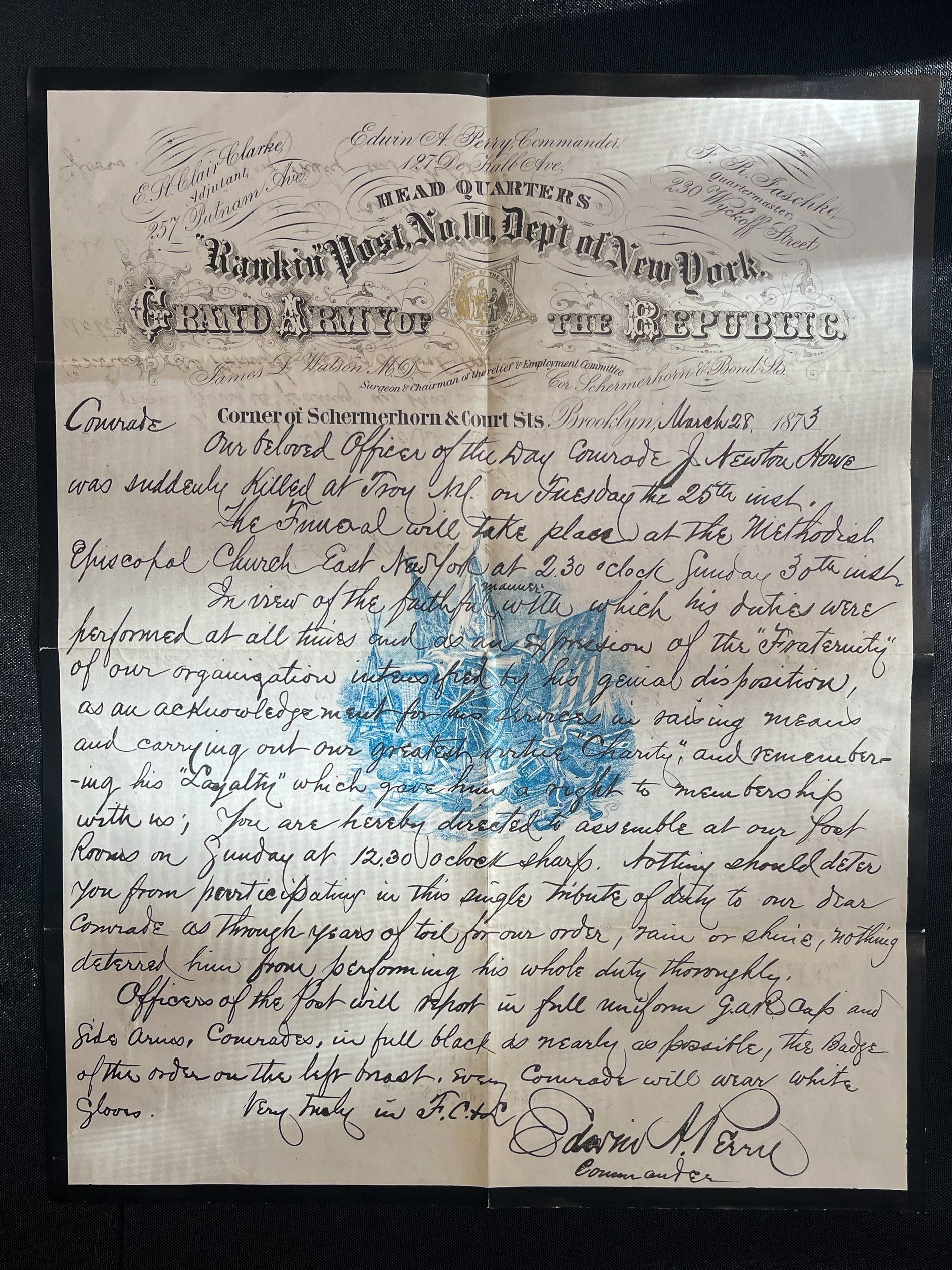
I was surfing eBay, as one does, looking for the weird and overlooked. My entire interest is built around finding that one strange letter that talks about someone mostly everyone has forgotten. This letter caught my eye because it was beautiful to look at. I struggled to read it based on the blurry eBay images. But one sentence stood out.
"Our beloved Officer of the Day Comrade J. Newton Howe was suddenly killed at Troy N.Y. on Tuesday the 25th inst."
Old paper is full of death. People "depart this life," they are "called home," they "pass away". Victorians had ritual upon ritual around death. I have an entire pile of Victorian calling cards in my inventory that are edged in black, just like this letter. They are tiny surviving advertisements that someone, somewhere, was in mourning. So, the black border on this letter didn't surprise me. But that one word did.
Killed
Nothing to grab my attention like an odd word placement, in the middle of a very formal letter. I needed to know how J. Newton Howe got himself killed in Troy. So I dug up newspapers.com and went to work.
The letter was written on March 28, 1873, three days after Howe's death. It came from Rankin Post No. 10 of the Grand Army of the Republic. This was a veterans' organization that sprang up after the Civil War. The Commander was summoning members to Howe's funeral. Officers were to arrive in full GAR uniform with side arms. Everyone else was to wear black "as nearly as possible," the badge of the order on the left breast, and white gloves. They were to assemble at 12:30 sharp. Whoever J. Newton Howe had been, his death merited formality and attention.
The letter is theatrical in the way only Victorians could be when it came to death. It has the black border. The GAR emblem is massaged into the ornate letterhead. Blue military imagery spills through the center of the page. At the bottom the Commander signs off "in F.C.&L.". I had to dig around for that a bit. Turns out this was the GAR's three principles: Fraternity, Charity and Loyalty. The Commander even went so far as to work those principles into his description of Howe.
So Who Was Newton Howe?
His full name was John Newton Howe, though he apparently went by Newton. He was born in Essex, England in 1844. According to birth and census records, his father was a brushmaker. Newton eventually followed him into the same trade. And if you're wondering what a brushmaker is, it's exactly as it sounds. At that time, brush manufacturing consisted of the entirely manual process of someone painstakingly inserting hair into the handle of a brush, piece by piece. Skilled and repetitive work.
That little fact turned out to matter more than I expected.
Howe would later become president of the Brushmakers' Benevolent Association of New York. He was also a Mason, a Civil War veteran and Officer of the Day of Rankin Post No. 10. He was only twenty-eight years old, but he seems to have been woven tightly into several different communities at once: veterans, Masons, labor organizers, tradesmen, church people, and friends. One of the obituaries claimed he was one of the most "promising young men in New York".
He had also been acting.
Shortly before his death, Rankin Post staged a charity production. Howe played a character named Alfred Thornton. After the final performance, he came up to two other cast members to say goodbye. They joked that he should also bid goodbye to Alfred Thornton. Howe reportedly raised his hat and replied, "good bye, forever." Those two men never saw him alive again. The Victorian press could not resist including that detail in his obituary.
Nineteenth-century newspapers loved death omens, last words, coincidences, dreadful foreshadowings and little moralities at the end of a story. Honestly, same. If someone said "good bye, forever" eight days before dying, you could be absolutely certain it was going in the paper.

The Trip To Troy
A few days later, Howe and another brushmaker named Sheehan made a trip to Lansingburgh, near Troy, to establish another brushmakers' union. By newspaper accounts, they were successful and on the 25th of March, returned to the Union Depot to catch the 4:30 train home to New York. Newton bought an accidental life insurance ticket for $3,000. It cost him twenty cents.
This sounds impossibly ominous now, but travel accident insurance was a real thing in the nineteenth century. It could be bought cheaply for a journey, almost like an add-on at the station. Howe's purchase therefore was probably not some solemn act of estate planning. It may have been closer to, "Twenty cents? Sure, why not."
Still, the newspaper headline that followed is difficult to improve on:
"A $3,000 Accidental Life Insurance Ticket Purchased and the Holder Killed Five Minutes Afterwards."
Howe and his companion had time before the train left, so they went into a nearby saloon for a few parting drinks. They kept checking to see whether the train was ready. Eventually they checked too late. It had begun to move.
So they ran for it.
Sheehan tried to board and managed to get onto a rear car. Howe grabbed the iron bars of a platform and attempted to pull himself aboard the moving train, but instead struck a pillar placed dangerously close to the track. The impact threw him from the train. He fell beside the rails and then rolled beneath the moving car instead of away from it. He saw the wheel coming and put his hand up toward his face. The wheel passed over his head, and he was killed instantly. His friend Sheehan was so distressed by what he had just seen that he had to be led away.
Just minutes earlier, Newton Howe had paid twenty cents for $3,000 in accidental death insurance. Four days later, his father was in probate court.
Howe left no wife, children or will. His entire personal estate was valued at about $250. The insurance policy was worth twelve times that amount. The timing makes it hard not to wonder whether that twenty-cent insurance ticket was the real reason his father needed to have himself formally appointed administrator so quickly.
Trigger warning: This article is gruesome in detail.

Then They Brought Him Home
This is where the Victorians REALLY take over.
His funeral was enormous. The Methodist church in East New York was crowded. The papers said it was the largest procession in New Lots (what is now part of Brooklyn) history in years. His coffin was handsomely mounted and decorated with a floral American flag. An actual Stars and Stripes was placed on the lid, along with Howe's service sword.
But his face could not be shown. The newspaper said his features were "not recognizable." So they placed a portrait of Newton on top of his coffin.
Afterward, a regimental band led the funeral procession. A GAR firing party followed. There were pallbearers and the hearse, family carriages, members of Howe's Masonic lodge, the Brushmakers' Benevolent Association, members of multiple GAR posts, friends on foot and still more friends in carriages. As the coffin was brought out, the band played Handel's "Dead March" from Saul. They played dirges on the road to Cypress Hills Cemetery.

At the grave, the veterans, the Masons and the brushmakers formed around him. Former New York lieutenant governor Stewart L. Woodford delivered a eulogy. Three volleys were fired over the grave. Then the Masons took over and conducted their own burial rites.
This man was not famous. I had never heard of him before I bought the letter, and neither, probably, had almost anyone else alive today. But this is what I really love about Newton. In 1873 he was deeply embedded in his world. His fellow tradesmen knew him. Veterans knew him. Masons knew him. His church knew him. He had spent the previous days traveling to another city to organize working men in the trade he shared with his father. When he died, all of those people came to get him.
And then there is the letter itself, which survived all of it. Someone kept it neatly folded and out of the light for 150 years. It looks almost new, but holds an astonishing amount of vanished language.
That's not why I bought it. I bought it because the writer said Newton Howe had been killed, instead of saying he had died.
The Victorians would probably have considered the whole thing terribly affecting.
Honestly, same.