I buy dead people's papers. Not because I'm morbid (well maybe a little) but mostly because I'm nosy.
I bought a small collection of papers at auction. The largest majority were related to the Balbach family, Gilded Age industrialists. I was overwhelmed staring at the 40-pound box of paper so I decided to start at the top and take you, gentle readers, on this journey with me.
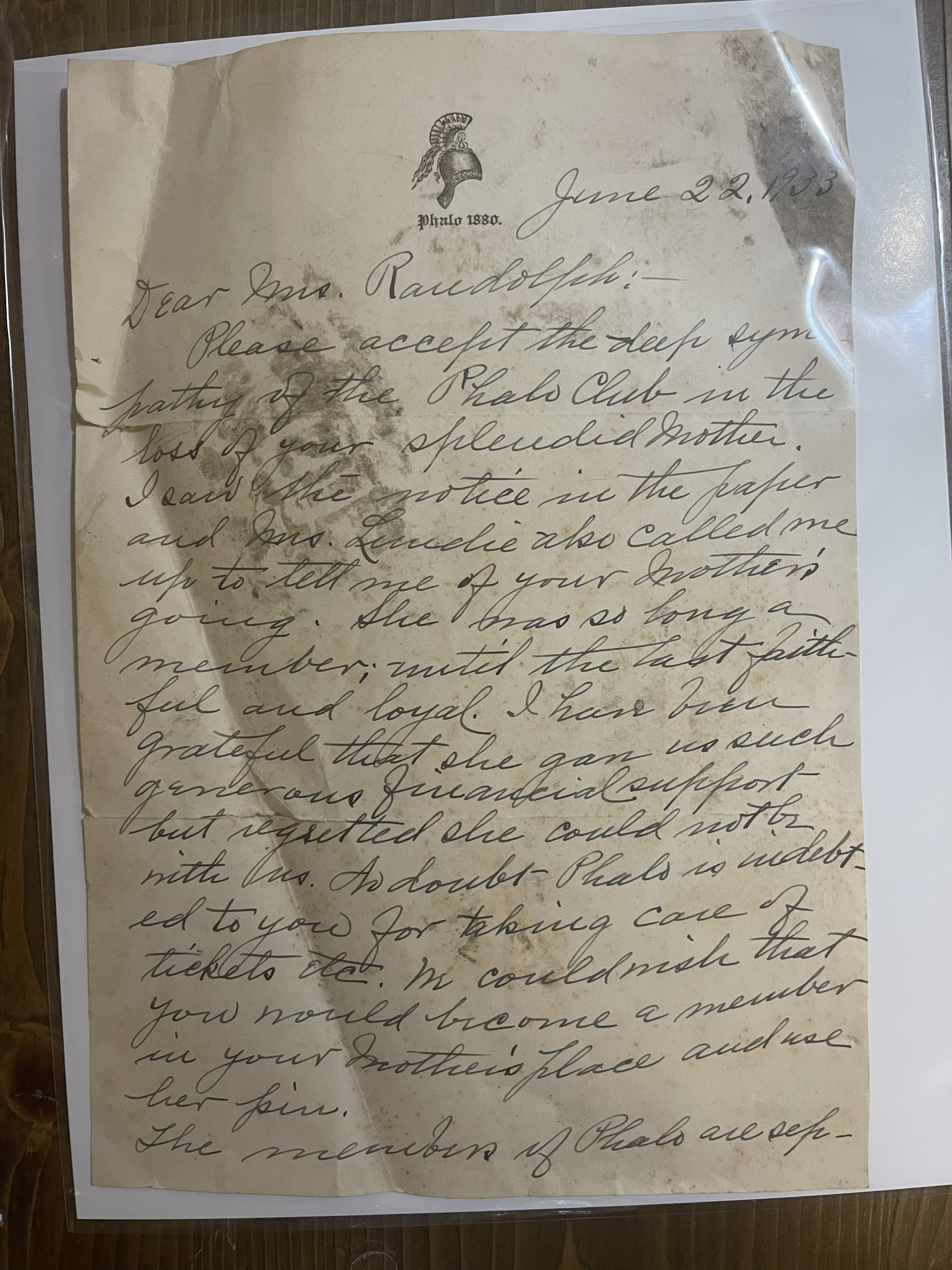
The first letter happened to be a condolence note. Interesting to start with the death of the woman whose life I wanted to investigate. One page, cream stationery, a little gold Spartan helmet stamped at the top with the words Phalo 1880. It looked like some secret club, Masonic-type shit so I got excited. A secret to unravel.
The reality was much less secret but also pretty damned interesting and turned me onto some history that I think we all should have been taught.
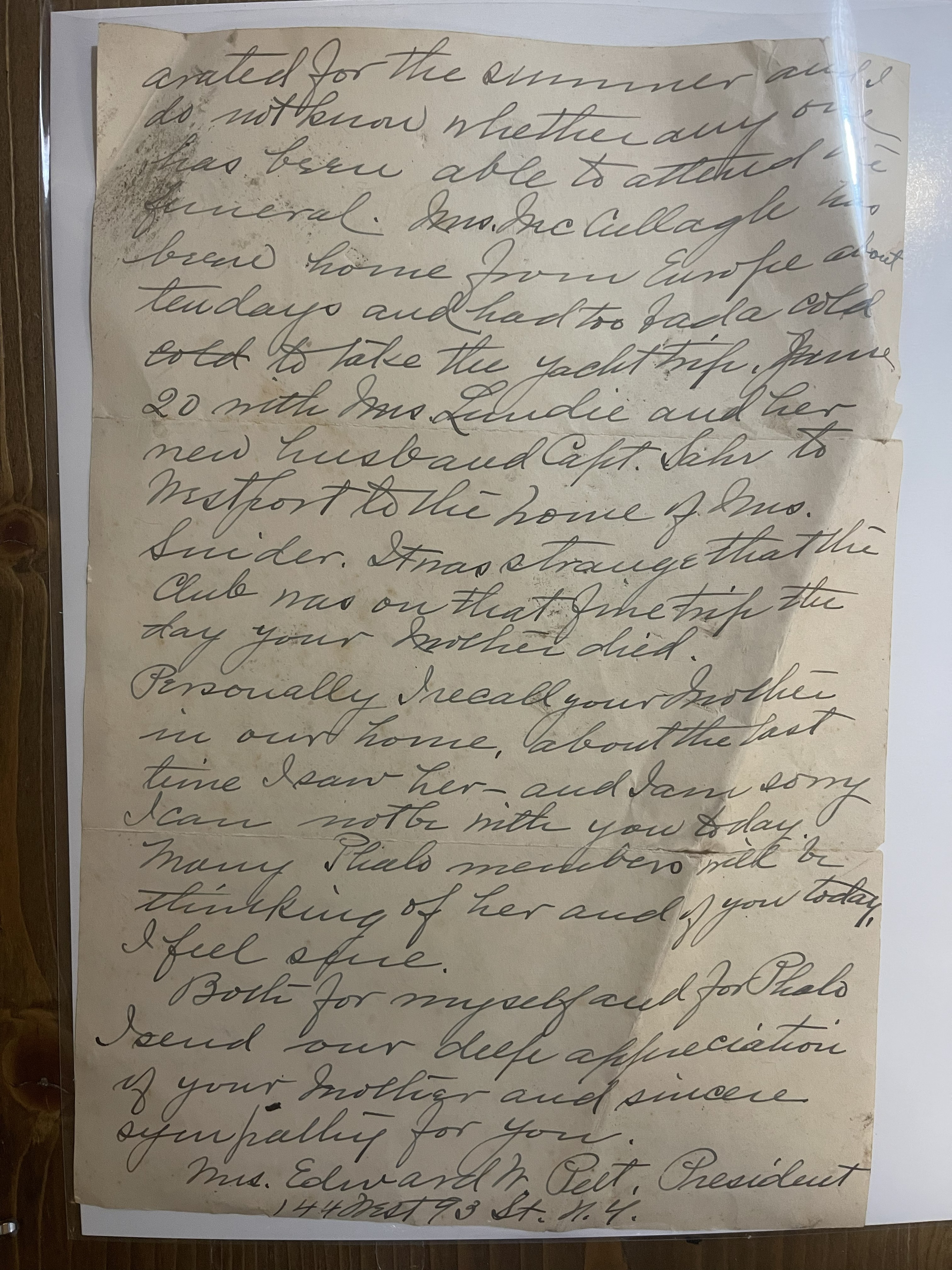
The letter was dated June 22, 1933 and written by the president of a women's club I'd never heard of, to a woman whose mother had just died. It starts with sympathy but quickly devolves.
Within a few lines, the president is praising the dead woman's "generous financial support," thanking the daughter for handling logistics, and then, in the same breath as I'm sorry your mother is dead, asking the daughter to take her mother's seat in the club and "use her pin."
Oh, and while the mother was dying? The club was on a yacht trip to Westport.
The president notes this. "It was strange," she writes, "that the Club was on that fine trip the day your mother died."
Yeah. Strange.
I stared at this letter for a while. Then I started investigating.
What the Hell is Phalo?
Phalo exists online mostly in mentions in Society columns. I eventually found a newspaper clipping from the late 1930s that explained it: Philosophy, History, Art, Literature, Oratory. Founded in 1880 by three women who met on a ship home from Europe and liked each other's conversation enough to keep meeting on land. The original charter called for fifty members max to meet twice a month, in each other's homes. The paper called it "the mother of club presidents" and credited it with launching the New York City Federation of Women's Clubs.
Fine. An old ladies' club. Until I looked up the members.
The 1913-14 directory of Club Women of New York is digitized on the Internet Archive, and the Phalo roster includes names that bear some weight. The president that year was Charlotte Beebe Wilbour. She was a co-founder of the first professional women's club in America, colleague of Susan B. Anthony and Elizabeth Cady Stanton. Also on the roster: Rev. Antoinette Brown Blackwell and Rev. Phoebe Hanaford. There's an easy-to-peruse article connecting some of these women if you'd like to learn more.
Two ordained women ministers in a club of fifty.
The Part Nobody Taught Us
I've been thinking a lot lately about the intersection of wealth, politics, progressivism, and religion. We all have, I imagine. We've been sold a version of history where religion is the conservative force and secular activism is the progressive one. I bought that version for most of my life. But these women complicated it for me.
Antoinette Brown Blackwell wanted to be a minister. She completed the theology course at Oberlin College. It was the first coeducational college in the country. Then they refused to give her the degree. She got a Congregational church to give her a pulpit, but the clergy themselves wouldn't ordain a woman. So in 1853, a radical Methodist minister named Luther Lee performed the ceremony instead. She was twenty-eight years old. She couldn't vote. In most states she couldn't own property. But she could stand in a pulpit because one man and one congregation decided a woman's conscience was as valid as a man's.
She lasted about a year. The church taught that unbaptized babies were damned, and she couldn't preach that. She left, eventually became Unitarian, and spent the rest of her life writing and speaking on women's rights. Finally, at the age of 96, she was able to vote in 1920. How many of us today understand that specific type of tenacity?
Phoebe Hanaford was ordained Universalist. To my understanding, this is a tradition built on the idea that God's grace extended to everyone, not just the elect. She lived with a woman named Ellen Miles for forty-four years, protecting their "deep friendship" against all foes. She is often referenced as one of the progenitors of lesbian rights. Her Phalo pin sits next to a "Votes for Women" button in her collection.
For these women, it's easy to believe the theology came first. Every person has inherent dignity and a direct relationship with God. If that's true, women are full souls. If they're full souls, they're full citizens. If they're full citizens, they vote. The politics weren't separate from the faith. They were the faith.
The churches that supported them weren't fringe. They were the same churches that had fueled abolitionism. The Broadway Tabernacle in New York, a Congregational church founded in 1836 with abolitionist money, hosted Frederick Douglass, William Lloyd Garrison, and Sojourner Truth. According to its archival records at the New-York Historical Society, the church granted women voting rights within the congregation in 1871, nearly fifty years before the Nineteenth Amendment. The infrastructure for women's organizing was already built. These women just picked it up and aimed it at the next fight.
Not surprisingly, this was not always a unified front. Plenty of suffragists thought religion was the problem, not the solution. Elizabeth Cady Stanton published The Woman's Bible in 1895, arguing that scripture had been used for centuries to justify women's subordination. Was she wrong? Seems there were plenty of churches doing exactly that. The suffrage movement's own leadership split over whether to embrace or reject religion. Stanton's Bible project was so controversial that the National American Woman Suffrage Association voted to distance itself from it, worried it would alienate the church-going public they needed on their side. In spite of all that, they still, often, marched side by side.
So the movement was fighting on two fronts at once: against a society that used religion to keep women out of public life, and within its own ranks over whether religion could be part of the answer. What makes Phalo interesting to me is that it was a room where that tension probably existed but politely, but then again the fossil record is thin. The ministers and the money sat in the same parlor. The women who drew their authority from the pulpit and the women who drew their power from inherited wealth met twice a month in each other's homes and built organizational machinery together.
They were also not saints.
I ran across a new clipping that ran headlines I'm sure the organization didn't appreciate. It read "TROUBLE IN THE PHALO CLUB" with the subhead "Yesterday's Meeting One of Tears and Hard Feelings." The fight: Jane Cunningham Croly, founder of Sorosis and the General Federation of Women's Clubs, basically the godmother of the entire women's club movement in America, had placed a member on the State Federation convention program to represent Phalo without asking Phalo first. The club had already appointed its own delegate. The vice president stood up and said that neither Mrs. Croly nor any other officer of the Federation could empower a speaker to represent a club. The replacement tried to withdraw her name. The club voted that motion down and unanimously re-elected her.
They told the founder of their own national movement to stay in her lane. Phalo protecting its autonomy against top-down Federation control. After this, a member told the press there had been "no indignation and no excitement." Which is exactly what you might say to a newspaper when there was plenty of both.
I love this because it makes them real. They weren't a painting of women in white gloves doing charity. They fought over delegate seats and cried at meetings and appointed committees to go explain things to the president of the State Federation. They had egos and turf and opinions.
I think that's why it worked. And maybe why nobody remembers it.
The Money and the Pin
Of course, institutions need money. And in Phalo's case, the money came from women like Julia Nenninger Balbach.
Julia's husband, Edward Balbach Jr., built the second-largest metal refinery in the United States. When he died in 1910, she was a wealthy widow living at the Bretton Hall hotel on the Upper West Side with a vacation home in Palm Beach, thirteen club memberships and a country estate in Bernardsville, New Jersey. She didn't just belong to Phalo, she seemingly belonged to everything. She was the financial scaffolding that helped to keep multiple women's organizations running.
The condolence letter makes this painfully clear. Mrs. Peet doesn't praise Julia's intellect or her conversation. She praises her loyalty and her "generous financial support." The dead woman had been bankrolling a club she was too frail to attend. The club was grateful for the money. It wanted the money to continue.
The Daughter
Which brings us back to the daughter, confusingly also Julia, now Mrs. Randolph, is the one the letter was written to. And thinking about her life has me shuffling through papers and articles until the wee hours.
She married Edward Randolph, whose father was the Confederate states attorney for the district of Arkansas during the Civil War. After the war, federal authorities required a loyalty oath to the Union. He refused to take it.
The mother championed Susan B. Anthony; the daughter married the son of a Confederate loyalist who refused a loyalty oath to the Union. You would think the dinner table conversation would be a minefield. But the Gilded Age was expert at gilding over the cracks. Northern money was washing over Southern debts, and I can imagine that polite society prioritized the merger over the cause. If there was a war in that house, I suspect it was fought the way the daughter seems to have lived: in silence.
The son came north, went to work for Julia's father, married the boss's daughter, and took over the refinery when the old man died. Was it a love match or succession plan? Unknown to me right now. I'm hoping the rest of the papers will illuminate some of that. The baby, their only child, had died on the day it was born. Then Edward Randolph dropped dead at his desk. The refinery closed.
By the time the condolence letter arrived in 1933, Julia the daughter had been a childless widow years, her family's company was gone, and her mother, the woman whose gravitational field she'd lived inside her entire life, was dead.
Mrs. Peet asked her to take the seat. Wear the pin. Keep the checks coming.
She didn't.
Within a year, Julia Balbach Randolph was dead too. She left money for the care of the animals at the family estate in Bernardsville, New Jersey, and a newspaper reported that she called them "her only true friends in life." She left her remains to the family attorney. Not to her husband's people in Tennessee. Not to her mother's relatives. To the lawyer and the animals.
Her Papers, But Where's Her Voice?
Here's what gets me about this collection: it's her papers, but she's not in them, at least not yet.
Her mother wrote a poem about the baby's death. The letters are addressed to her husband from his family. The clippings mention her attending teas and hosting events... performing. There is one very sad letter from Edward's mother about Julia's pregnancy, seemingly only days away. But I'm still looking for her voice. Something to contradict that one line... Her only true friends in life. I hope I find it.
Her mother's world included women who were ordained as ministers before the Civil War, who marched with Susan B. Anthony, who built the organizational infrastructure that got women the vote. Her mother wrote poetry and novels. The daughter inherited all of that... the money, the access, the pin, and none of it saved her.
I don't know what happened to her. I don't know if she was depressed, or content, or angry, or numb. I've ordered her will from the Surrogate's Court, and maybe those documents will tell me something, as well as the other 39.99 pounds of paper in the Balbach box.
But right now, what the papers tell me is this: the coalition her mother helped build - this very specific alliance of progressive religion, industrial money, and women's organizing - died when the women who built it died. Nobody's daughter picked up the pin.
I think we're still paying for that.
This is the first piece I'm writing from the Balbach papers. The letter was on top. I don't know what's underneath it yet.
If you know anything about the Phalo Club, the Balbach family, or any of the women mentioned here, I'd love to hear from you.
I'm not a historian. I'm a person with a box of papers, opinions, and an internet connection. Corrections welcome.