Ordinary people exist in historic times. We tend to think of "History" as something that happens to Kings and Presidents, but the rest of us? We are the grist in the mill. We are the ones who leave marks through generations without ever meaning to.
This is why I buy old papers on the internet.
And now I find myself staring at a signature written in 1891. It's bold, but loosely flourished. It bears the weight of years in solid black ink.
Julius Haas.
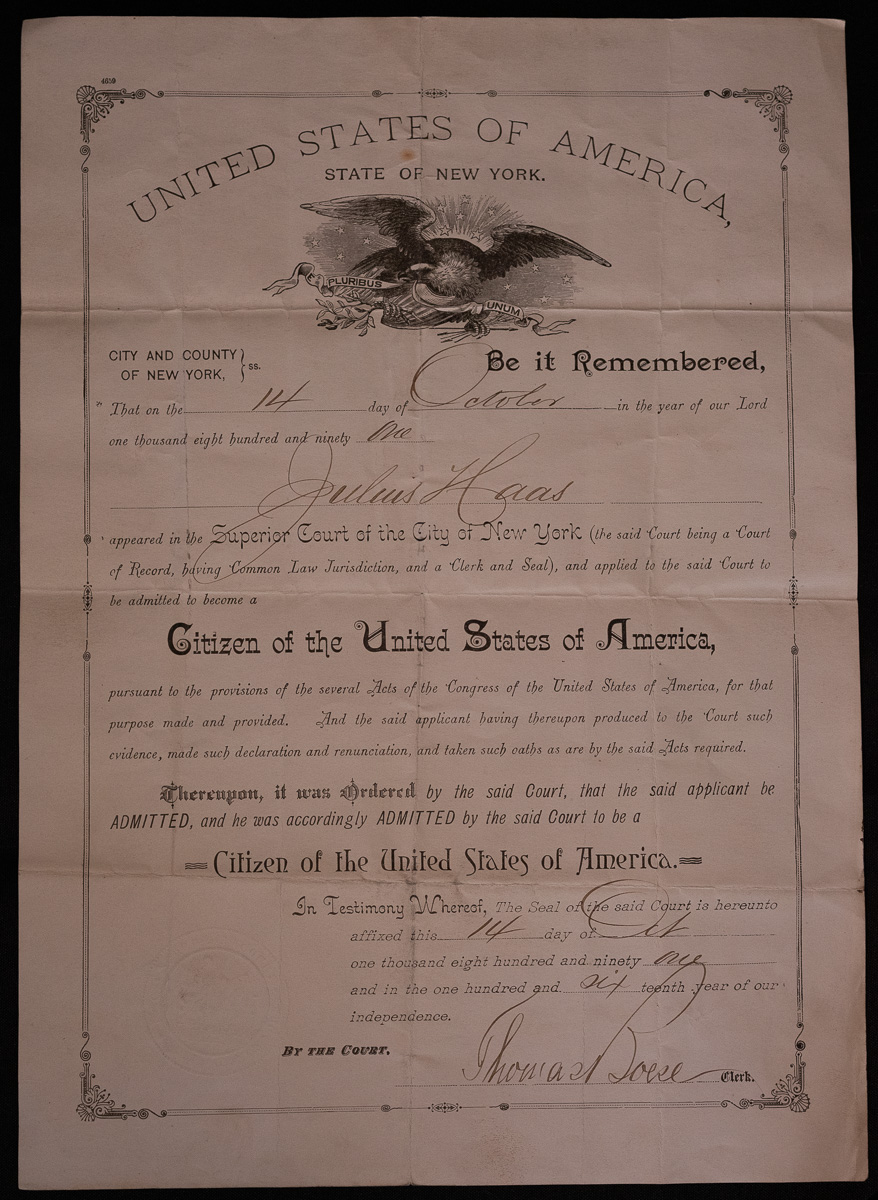
The naturalization certificate for Julius Haas, 1891. Author's collection.
I found him on a naturalization certificate I bought on eBay for $30. He was lumped in with a vintage TV fan magazine and a truly hysterical postcard about sweet Bermuda onions. It's a whole vibe. But something about that made me a little sad.
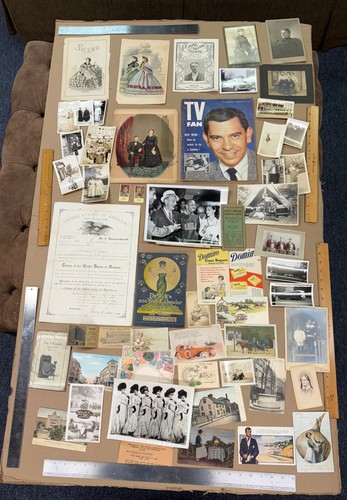
eBay listing containing the naturalization certificate
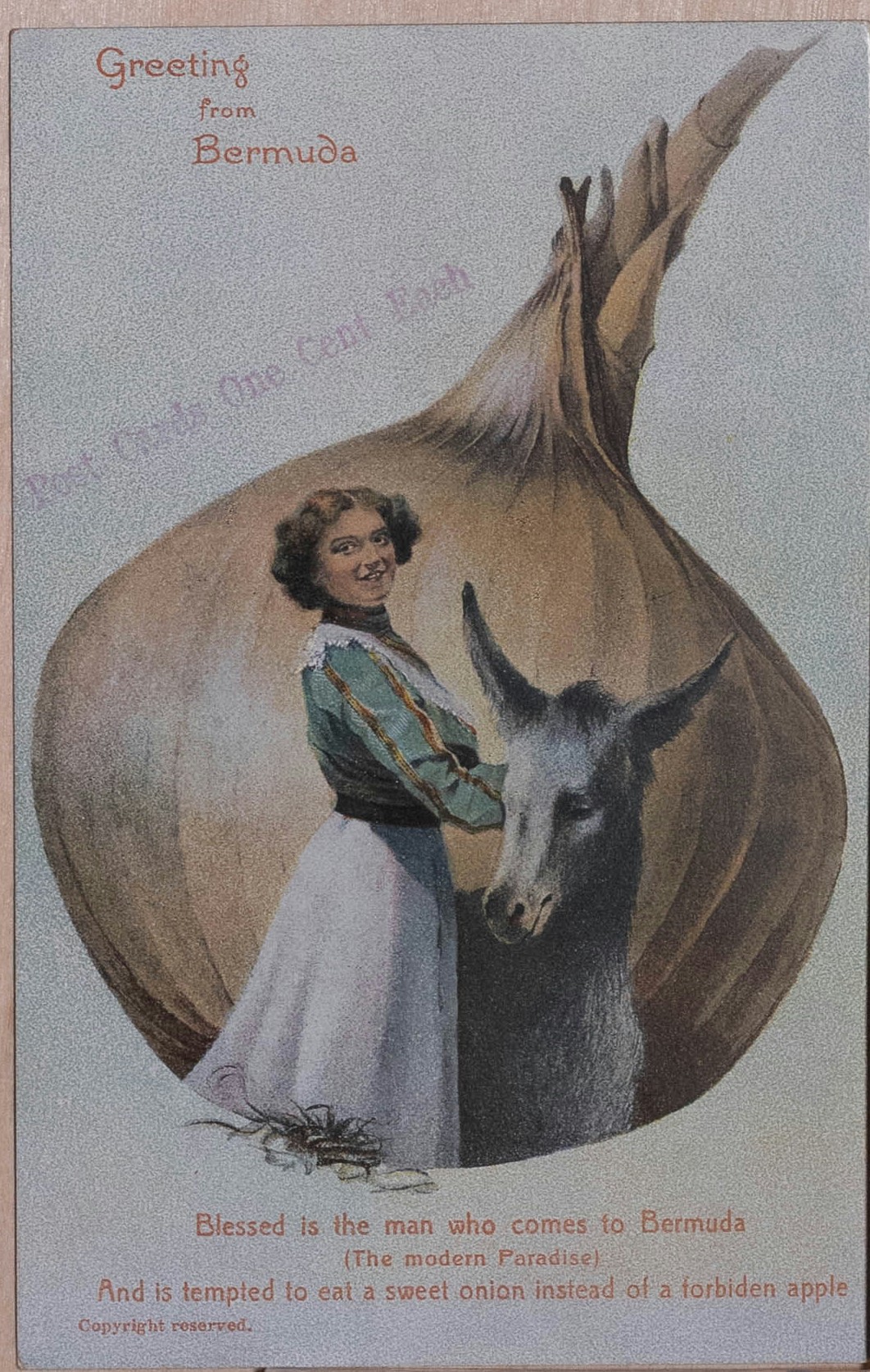
19xx postcard from Bermuda about their sweet onions
It was a momentous piece of paper -- a passport to a whole new life -- just shuffled into a box of junk only to end up on eBay with pictures of the Floradoras and vacation postcards.
I had a mystery on my hands and every mystery needs a hook. Mine was the witness line on Julius's certificate. Philip Hubert. He was famous for being the architect of the Chelsea Hotel and held sometimes radically progressivist ideas about workers and wealth. He was a character, and I desperately wanted them to know each other. It was the first thread I pulled, but I couldn't connect them. As disappointing as that was, I was still invested in Mr. Haas, even without the famous friend. I couldn't let him go just yet. I had his "citizen" records, but I had nothing of the human.
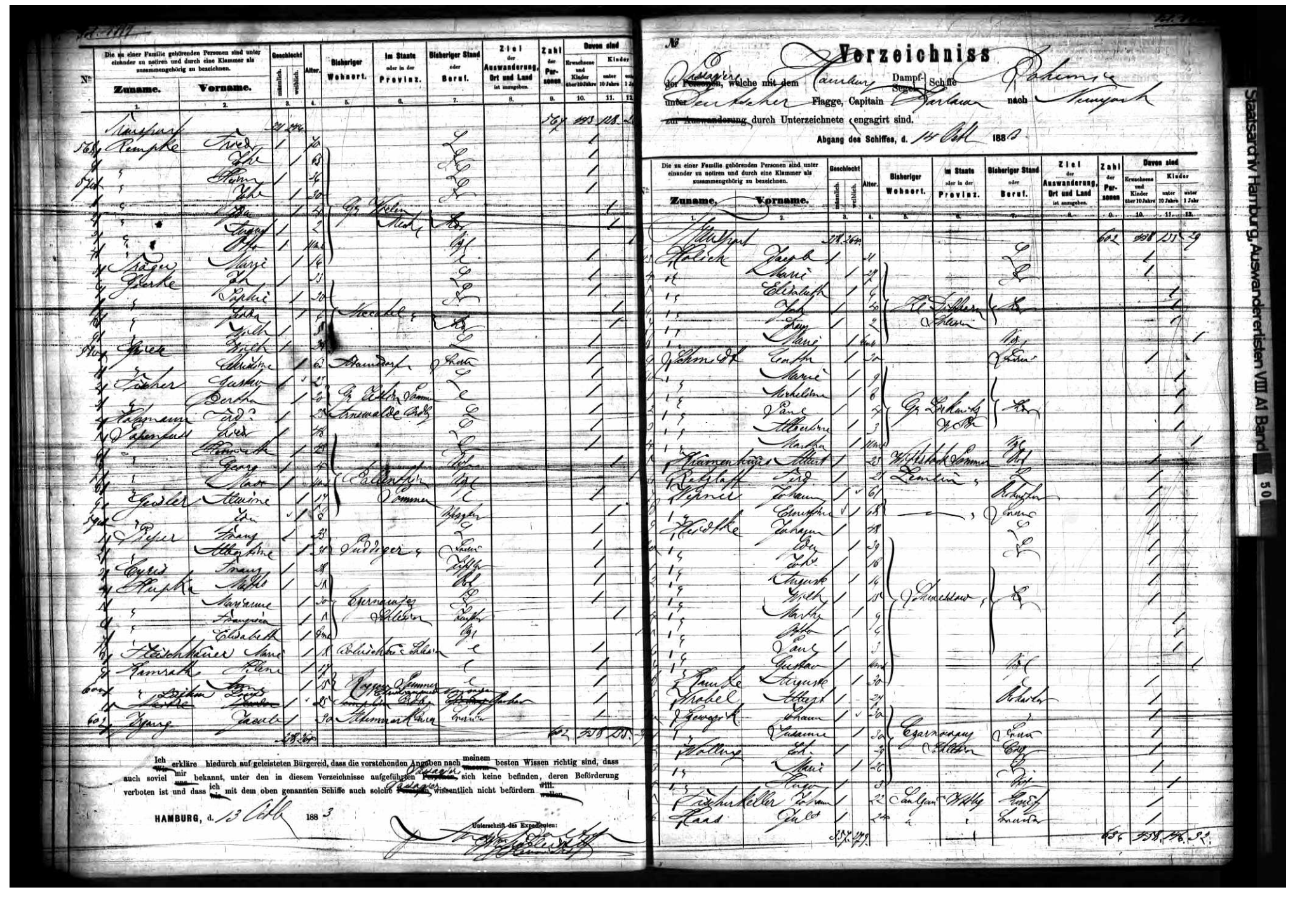
1883 S.S. Bohemia Ship Manifest. The exact ship manifest listing Julius Haas' entry to the US. He's on the right page, very bottom.
To understand the man, I had to look at the world he left behind.
Julius was the third youngest of 15 -- FIFTEEN -- children baptized Catholic in the Rottenburg-Stuttgart diocese in Württemberg, Germany. He was born in 1860, right as Chancellor Otto von Bismarck was launching the Kulturkampf. Apparently Bismarck didn't have enough power so he gutted the Catholic church in Germany. Julius would have seen priests arrested for saying the wrong words at the pulpit, catholic papers silenced, and he would have watched, in 1875, as the government confiscated every last bit of Catholic property. All. Of. It. Over a million Catholics were deprived of the sacraments because thousands of priests were in exile or in prison. Julius would have been 15.
I don't know if this drove him to leave Germany or if he just wanted to stake his claim in the "new world" but it undoubtedly left its mark.
When he arrived in the United States, he would have found a world not so different from the one he left. Anti-Catholic sentiment was about to reach a peak on our home shores. The fear was always the same. Catholics were taking jobs, controlling cities, answering to a foreign power in Rome. It organized itself under different names in different decades. The Know-Nothings in the 1850s, the APA in the 1890s. The tactics were the same.
This hit home for me. As a young child, I was forbidden to walk past the Catholic church in our town. We had to cross the street first. I had Catholic friends; we just didn't talk about it. They weren't at our church functions eating lefsa and lutefisk or singing our Baptist hymns. At the time, I chalked this up to my family just being weird and a little backward. In my adulthood, I would defy them and adopt Catholicism for myself. But even then, I didn't know the history that had shaped them.
No one had taught me about the Anti-Catholic riots in 1844 that tore through Philadelphia for three whole days, leaving people injured and dead and churches burned. A little over a decade later, "Bloody Monday" in Louisville happened. A mob descended on the election polls to block Irish and German Catholics from voting. There were beatings, lootings, arson, and murder. German businesses and homes were burned. Catholic churches vandalized, the Eucharist desecrated. There were even loaded cannons involved. At the end of the day, only 20 of the 1000ish eligible Catholic voters cast a ballot. 22 people were dead, yet no one was convicted. Around the time of Julius' arrival, the APA was on the rise. This organization's members swore never to hire, vote for, or strike with Catholics. By the mid-1890s, the organization claimed over two million members. We wouldn't even have a Catholic President until JFK in 1960 and even then, he was basically forced to speak about how his faith wouldn't interfere with his governance.
In the small, midwestern town of my childhood (and one could argue the breadth of the United States), the screams of Bloody Monday were still playing in our heads not quite 150 years later. It takes awhile for violent echoes to fade, I guess.
The through line from burning convents in the 1830s to questioning a presidential candidate's loyalty in 1960, Julius lived through the middle stretch of all of it. He left Germany's Kulturkampf only to find its counterpart in the United States. After these groups imploded under the weight of their own hubris, Julius continued on by swinging a hammer and raising a family.
On October 14, 1891, Mr. Haas and Mr. Hubert would have walked out of this courthouse having made not just Julius, but his entire family official citizens of the United States. Therese and all of the children would achieve their own status by virtue of Julius signing on the dotted line. They weren't even required to be present. All this, almost eight years to the day of his arrival. He signed away his allegiance to the German Emperor -- "I do absolutely and entirely renounce all allegiance and fidelity to the Emperor of Germany." while Mr. Hubert witnessed Julius to be of good moral character. And Julius vowed to uphold the Constitution. He would officially be 'one of us'.
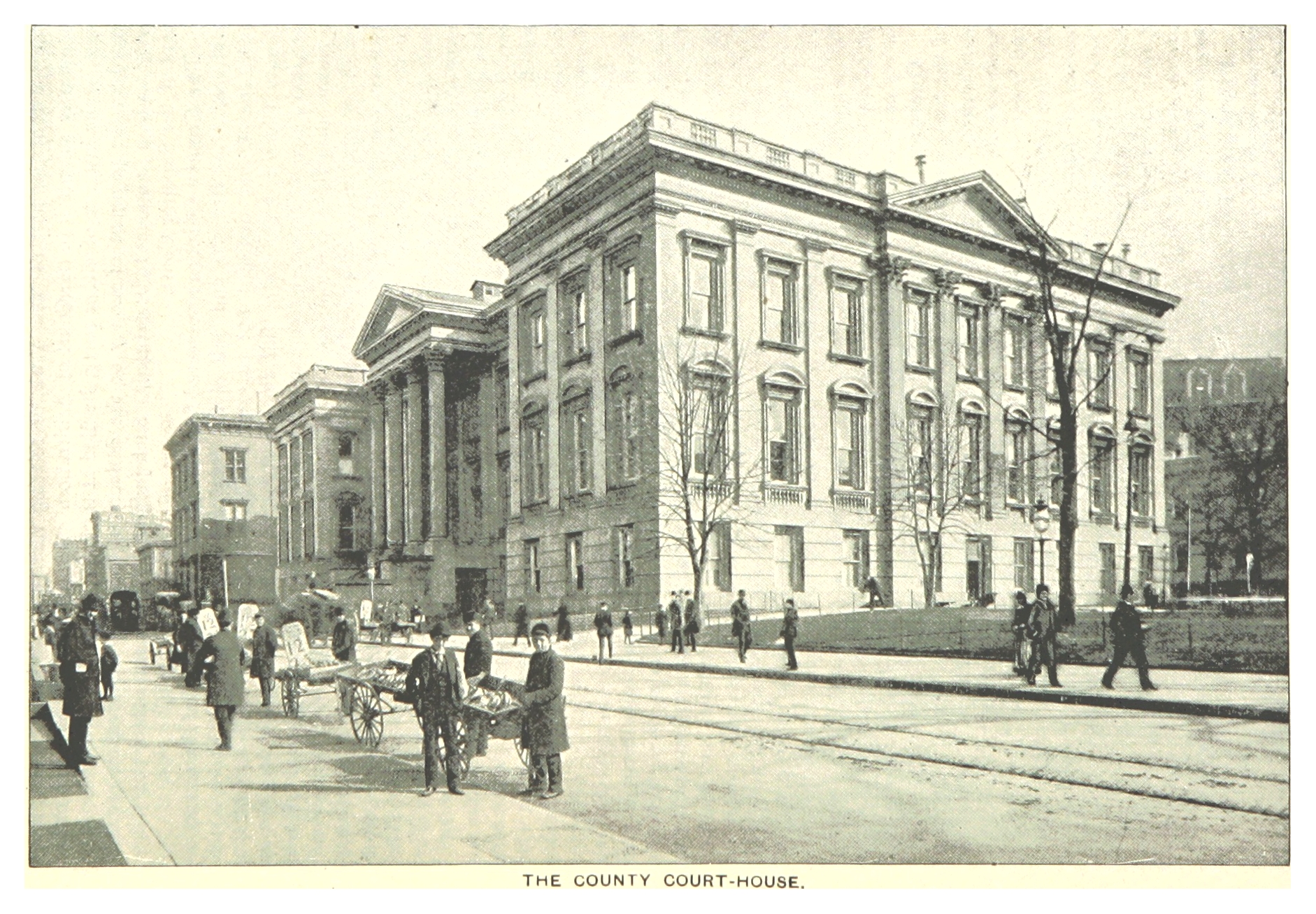
1885 photo of the Tweed Courthouse home of the then Superior Court of New York
Julius and Therese would have six children, but they would lose their second son, Alfred, at 4 months of age. Jakob and Frances would go on to marry and the leave home but Frank (the second son), Anna, and Sophie never would.
Julius would go back to Germany... twice ... even after disavowing the Emperor.
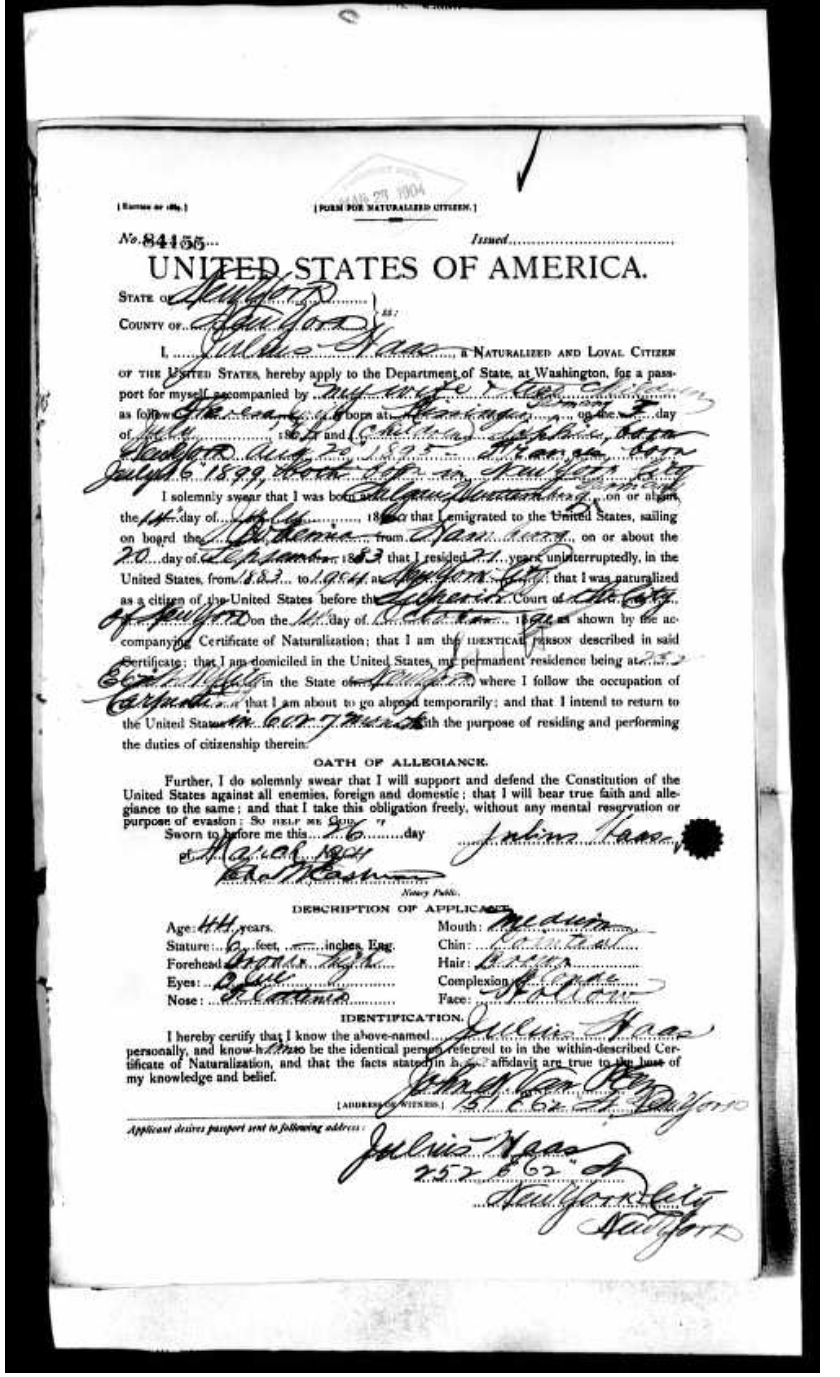
1904 passport application
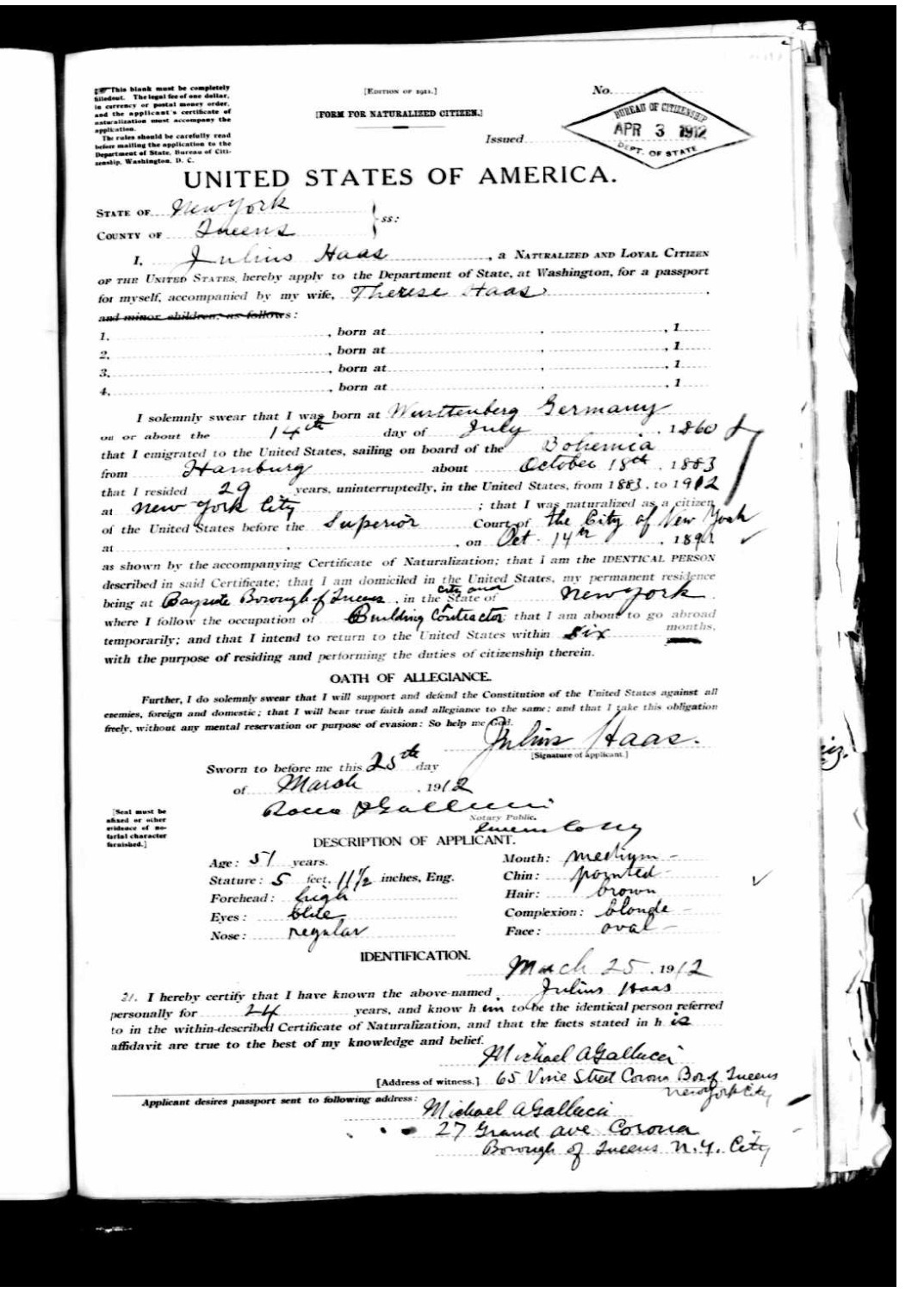
1912 passport application
Their family life took a mostly typical arc through the Great Depression. Their home's value declined from $20,000 to $8,000. Where once they owned their own business and "worked of their own accord", they were bounced back to unemployment and "seeking work". Julius came out of retirement. I don't know how late into his life he worked. The only college-educated person in the family, Sophie, was a teacher and supported them on her annual income of $3830. Anna is still there, listed a homemaker, as she was on every single census between 1892 and 1950.
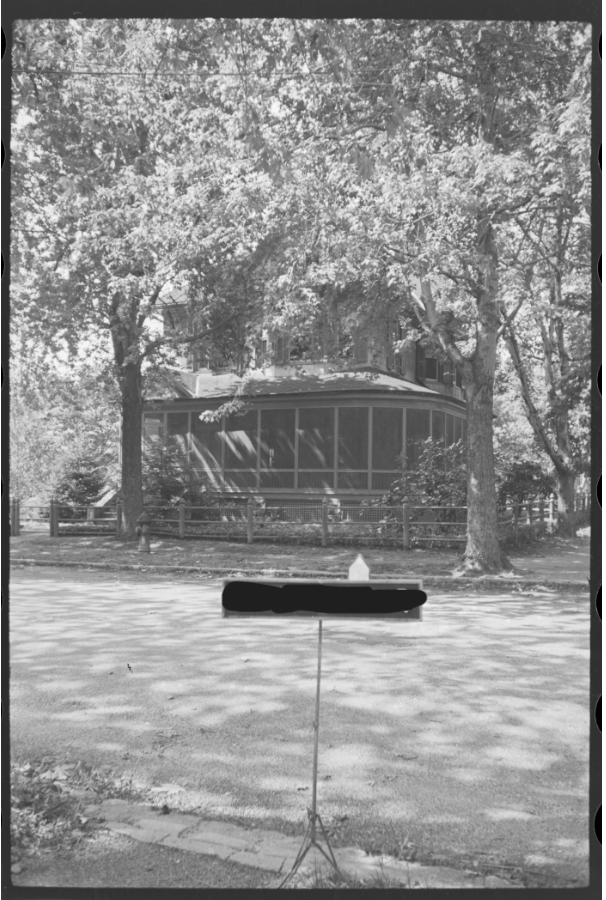
1940 Tax Photo of the Haas home
And then there is Frank.
He was the eldest son, a WWI veteran who never called himself one. He was likely working alongside his father. Never married, no children. He wouldn't be the one to carry on the family line. It seems Frank finally slips the tether of the family home and disappears, though I "think" I found him living on a farm in New York. Close but no longer under the same roof.
Julius would be dead a few months after the 1950 Census and laid to rest next to his wife and infant son at the Holy Rood Cemetery in Westbury. Ultimately Frank, Anna, and Sophie would also be buried next to their parents.
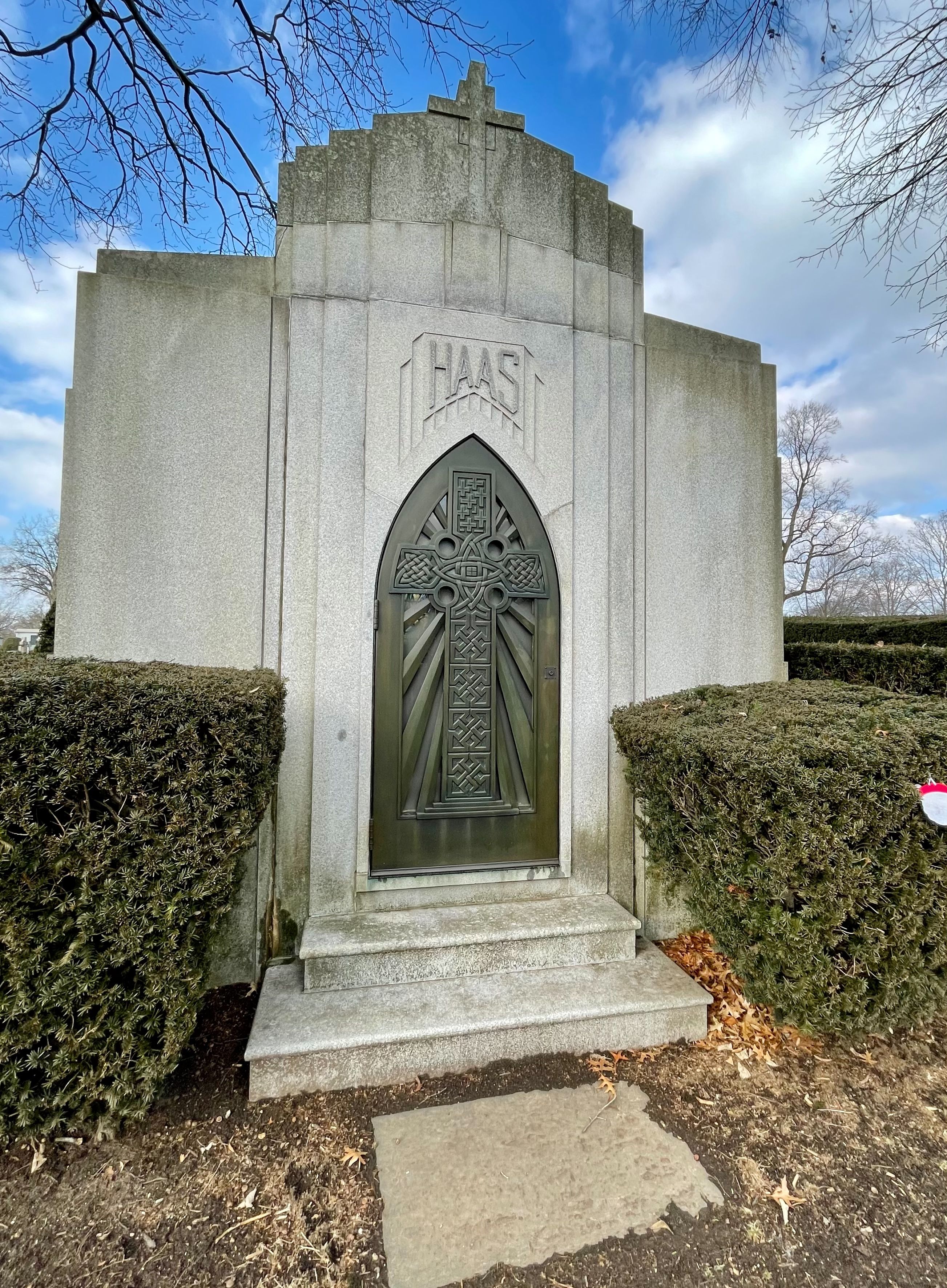
Haas Family Mausoleum at Holy Rood Cemetery in Westbury. Photo courtesy of Find a Grave
Julius lived through Kulturkampf, a spot in steerage on a ship across a vast ocean. He witnessed the rise of the APA, the Great Depression, and two World Wars. He not only survived but built a family and a business from nothing to something. He came to a new world only to find traces of the old, and still he continued to build, nail after nail. He wouldn't, however, live to see JFK elected first Catholic president, Vatican II which modernized the Catholic Church, the dismantling of the national-origins quota system that was put in place by the same nativist impulse that produced the APA. He'd miss the moon landing and maybe most importantly the rise and fall of the Berlin wall. His home country torn apart by war and division, madmen and all, only to be put back together again.
I think about all of that when I stare at this piece of paper.
If you have any information, corrections, etc., please reach out! If you are a direct descendant of Julius and would like this certificate, I would be happy to pass it on to you and learn more about your family.